Benchmark results
Results
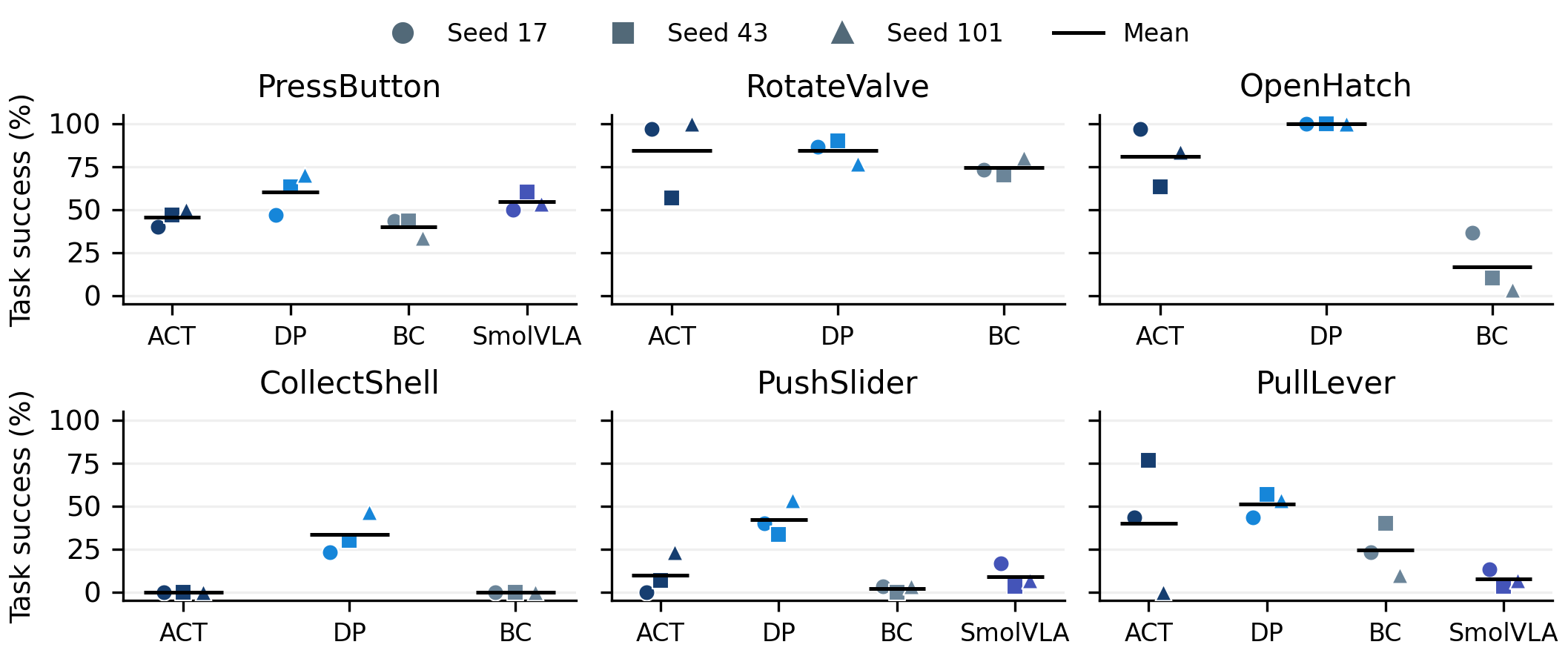
Success (%) · mean ± sample SD over three trainings, each evaluated on 30 resets.
| Task |
ACT |
DP |
Chunked BC |
| PressButton |
45.6 ± 5.1 |
60.0 ± 12.0 |
40.0 ± 5.8 |
| RotateValve |
84.4 ± 24.1 |
84.4 ± 6.9 |
74.4 ± 5.1 |
| OpenHatch |
81.1 ± 16.8 |
100.0 ± 0.0 |
16.7 ± 17.6 |
| CollectShell |
0.0 ± 0.0 |
33.3 ± 12.0 |
0.0 ± 0.0 |
| PushSlider |
10.0 ± 12.0 |
42.2 ± 10.2 |
2.2 ± 1.9 |
| PullLever |
40.0 ± 38.4 |
51.1 ± 6.9 |
24.4 ± 15.0 |
Equal training sample exposure does not equalize compute, encoders or observation
history. All runs, including failures, remain in the table. Zero sample SD is not
population certainty. These new procedural-asset results are separate from the
historical CAD-profile scores.
Policy × control. Removing integral action changes OpenHatch from 30/30 to
0/30 for every DP training seed and reduces completion on RotateValve. Early
grasp occupancy rises on Hatch and falls on Valve: contact alone does not order
completion. Seven conditions per task include published-coefficient sensitivity.
Controller and contact graphs

[All conditions and interpretation](https://github.com/dancher00/wasserman/releases/download/v0.1.0/wasserman-reproduction-sources-v0.1.0.tar.gz#docs/reviews/revision-v2-controller-review.md).
Action interfaces. On reserved research resets, native targets versus EE
produce 43.3% versus 8.9% on PushSlider. PullLever's +3.3 percentage-point EE
contrast remains unresolved. Expert replay passes both interfaces on both tasks.
Action-interface graphs

[Complete comparison and uncertainty](https://github.com/dancher00/wasserman/releases/download/v0.1.0/wasserman-reproduction-sources-v0.1.0.tar.gz#docs/reviews/revision-v2-interface-review.md).
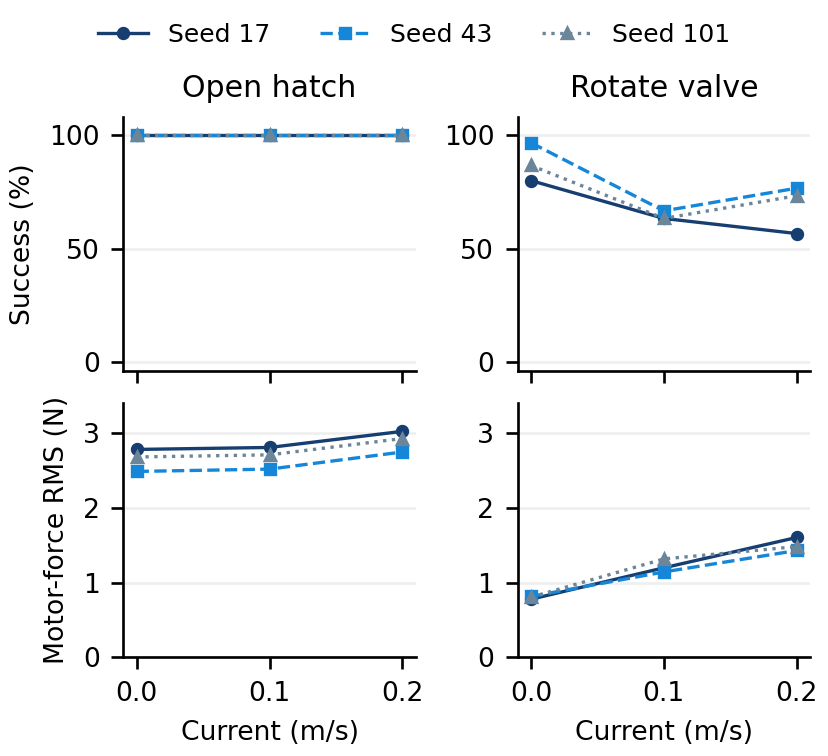
Water current. Three frozen DP checkpoints per task, three current levels and
30 matched resets give 540 episodes. RotateValve changes from 87.8% to 64.4%
at 0.10 m/s. OpenHatch retains full observed completion at 0.20 m/s while early
motor-force RMS increases 9.4%. All levels and seeds are shown; the Valve
success response is not monotonic.
Protocol, paired contrasts and videos.
Execution variation. All 54 primary models were rerun on a second workstation.
The equal-task ordering DP > ACT > BC is preserved; mean shifts are −1.5, −0.4
and −1.9 percentage points, respectively. Individual binary outcomes agree in
1,438/1,620 episodes. All task/model shifts.
These studies use separately versioned scenes and protocols. They are not
additional results of the open-core learning matrix.
Explore task-specific evaluations, two-arm manipulation and physical demonstrations
- **Nine evaluated tasks across separate protocols** — PressButton, RotateValve, OpenHatch, CollectShell,
PushSlider, PullLever, HotStab, CabinRecovery and CargoRelease.
- **ACT and Diffusion Policy baselines** — RGB observations and measured robot
state, selected checkpoints, per-state outcomes and scripted experts.
- **Floating vehicle–arm systems** — BlueROV2 with Reach Alpha for the six-task training comparison;
RexROV2 with Oberon7 in a separate articulated PressButton comparison: **30/30 each**, with paired resets and independent trace replay.
- **Two-arm manipulation** — a custom twin-Oberon Rex compares cooperative valve
turning, a support grasp and a parked arm: **30/30 in each mode**. The
[scripted comparison](https://github.com/dancher00/wasserman/releases/download/v0.1.0/wasserman-reproduction-sources-v0.1.0.tar.gz#benchmarks/bimanual-valve-v1/RESULTS.md) measures base motion
and motor load separately from the learned-policy benchmark.
- **Control interfaces** — end-effector targets and base/joint targets, inverse
kinematics, and PID/PD comparisons with a frozen policy.
- **Dynamic delivery demonstration** — [Wall Toss](wall-toss.md): a capsule passes through a wall in still water and strikes the rim under cross-current with identical high-level commands. One paired expert example, without ACT/DP scores.
- **Underwater effects** — currents, drag, buoyancy, motor limits and optional
boundary effects; visual water variations for inspecting image formation.
- **Controlled studies** — policy, interface, data-budget and physical-condition
comparisons with recorded protocols and paired test states.
Historical ACT / DP results · nine tasks · versioned evaluation protocols
| Task | ACT | Diffusion Policy | Protocol |
|---|---:|---:|---|
| PressButton | 10/30 | 16/30 | Shared CAD-profile protocol |
| RotateValve | 30/30 | 30/30 | Shared CAD-profile protocol |
| OpenHatch | 10/30 | 30/30 | Shared CAD-profile protocol |
| CollectShell | 0/30 | 28/30 | Shared CAD-profile protocol |
| PushSlider | 0/30 | 28/30 | Shared CAD-profile protocol |
| PullLever | 6/30 | 22/30 | Shared CAD-profile protocol |
| HotStab | 2/30 | 0/30 | Separate pinned study |
| CargoRelease | 3/30 | 1/30 | Corrected shipwreck v3 |
| CabinRecovery | 0/30 | 0/30 | Corrected shipwreck v3 |
One training seed per model/configuration; 30 task-specific test states per row.
HotStab, CabinRecovery and CargoRelease use separate observation/training protocols and are
excluded from the six-task average. Cabin geometry audits pass 27/30 ACT and
30/30 DP episodes; failures remain in the denominator. See [task-specific study protocols](extended-studies.md). Original scores, repeat variation and study limits are retained
in [Tasks, studies and limits](benchmark.md).
[**Watch cooperative valve turning**](https://dancher00.github.io/wasserman/docs/artifacts/) · Three-minute expert demo, real time and silent. [Three-mode results and limits](https://github.com/dancher00/wasserman/releases/download/v0.1.0/wasserman-reproduction-sources-v0.1.0.tar.gz#benchmarks/bimanual-valve-v1/RESULTS.md).
[**Rapid-command demonstration**](https://dancher00.github.io/wasserman/docs/artifacts/) · One matched reset, three modes, no overturn. [Measured response and audit limitation](https://github.com/dancher00/wasserman/releases/download/v0.1.0/wasserman-reproduction-sources-v0.1.0.tar.gz#benchmarks/bimanual-fast-turn-v1/README.md).